Key points
- Holladay requires permits for remodels of any size and for most electrical, plumbing, gas and HVAC work.
- Cabinets, trim, carpet, paint and like-for-like fixture or device swaps don't need a permit.
- Applications go through the city's iWorQ portal with a Building Permit Checklist, plus a Zoning Worksheet in R-1 zones.
- As of July 1, 2026, Utah's construction code adopts the 2021 International Residential Code and the 2023 National Electrical Code, among others.
- Check any contractor's license on Utah DOPL's lookup. The handyman exemption covers only work under $7,000 and still excludes most electrical, plumbing, gas and HVAC work.
- Utah's Lien Recovery Fund can no longer pay claims, but a DOPL Certificate of Compliance can still protect a homeowner who paid in full.
This guide summarizes public sources for planning purposes. It isn't legal advice. Holladay Kitchen Co. is not a contractor and does not pull permits; your contractor and the City of Holladay Building Division have the final word on your project.
What needs a kitchen remodel permit in Holladay
The City of Holladay's Building Division handles residential permits. Its FAQ is blunt: "All structural and some nonstructural work on your home or business requires permits." For a kitchen, the line falls roughly between changing what's behind the walls and changing what's on them.
| Permit required | No permit needed |
|---|---|
| Additions, renovations and remodels, "regardless of square footage or area" | "Cabinets, trim, carpet, paint" |
| Electrical: service upgrades, meter changes, new circuits | "Replacing interior electrical lights and receptacles with equivalent devices" |
| Plumbing: gas lines, water heaters, drain-waste-vent piping, water lines | "Replacing defective plumbing fixtures with equivalent fixtures" |
| HVAC work |
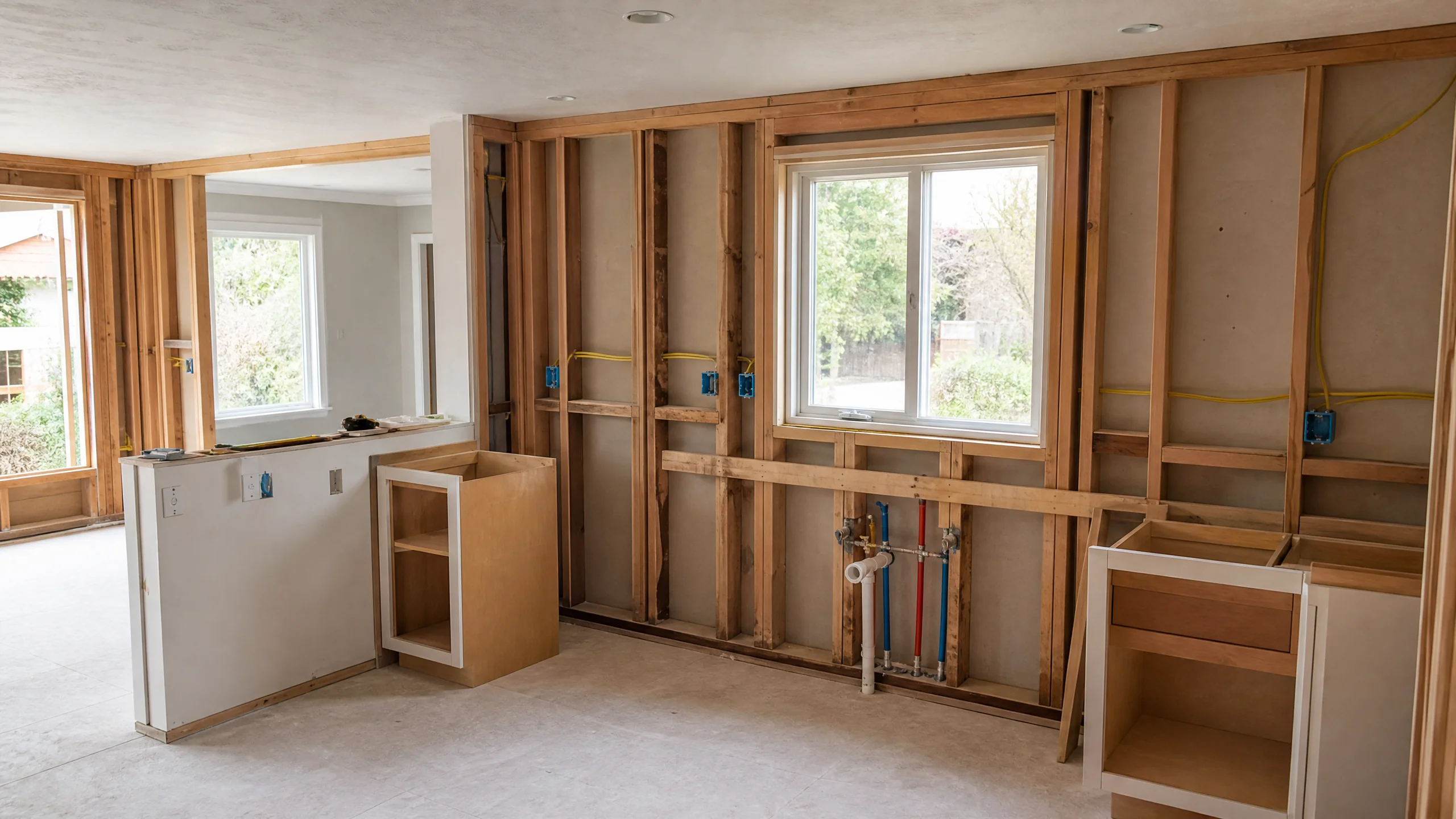
In practice, a project that only replaces cabinet doors, counters and paint may not need a permit. Once the plan moves a sink, adds an outlet circuit, runs a gas line for a new range, or removes a wall, it does. Most of the projects on this site, from layout reconfiguration to wall removal, fall on the permit side.
The state code says the same thing in broader terms. Section R105.1 of the 2021 IRC as adopted in Utah requires a permit to "construct, enlarge, alter, repair, move, demolish" a building or to install, alter or replace "any electrical, gas, mechanical or plumbing system." The exemptions in R105.2 include interior finish work, minor electrical repairs, and leak repairs that don't replace concealed pipe or rearrange fixtures.
Source: 2021 IRC (Utah), Chapter 1, R105.
How to apply for a permit in Holladay
Holladay takes permit applications through its iWorQ online portal. The Building Division says applications must include a Building Permit Checklist, and homes in R-1 zones also need a Zoning Worksheet. Both are linked from the city's Building Division page, which also lists current contact details.
- Finish the planA permit reviewer needs drawings that show what changes: walls, plumbing, electrical, gas and ventilation.
- Confirm who appliesThe FTC recommends that the contract spell out "the contractor's obligation to get all necessary permits."
- Submit through iWorQUpload the plans, the Building Permit Checklist and, in R-1 zones, the Zoning Worksheet.
- Answer review commentsEach correction adds a round of review, so a complete application moves fastest.
- Schedule inspectionsRough-in work is inspected before walls close, then a final inspection closes the permit.
Sources: City of Holladay Building Division; FTC, "Hiring a Contractor".
Timing is predictable by law. Utah Code 10-20-909 requires a city to finish plan review for a one- or two-family dwelling within 14 business days after the application's screening period ends, and Holladay's FAQ says the city strives to complete the first review within 7 business days. The Building Official also offers consultations by appointment if your plan raises questions. For how review fits the overall schedule, see the kitchen remodel timeline guide.
Sources: Utah Code 10-20-909; City of Holladay Building Division FAQ.
Which codes apply in Utah
Utah sets one construction code statewide, which applies to "building construction, alteration, remodeling, and repair." Cities enforce it, so the rules for a kitchen in Holladay are the same as in Millcreek or Sandy; what differs is the office that issues the permit.
| Code | Edition in effect as of 7/1/2026 | Kitchen work it touches |
|---|---|---|
| International Residential Code | 2021 | Framing, walls, general residential rules |
| National Electrical Code | 2023 | Circuits, outlets, lighting |
| International Plumbing Code | 2024 | Sinks, drains, venting, water lines |
| International Mechanical Code | 2024 | Range hoods and ventilation |
| International Fuel Gas Code | 2024 | Gas ranges and gas lines |
| International Energy Conservation Code | 2024 | Insulation and lighting efficiency |
| International Existing Building Code | 2024 | Work on existing buildings |
One code detail shows up in nearly every older kitchen: IRC E3703.2 requires "a minimum of two 20-ampere-rated branch circuits" for kitchen and dining-area receptacles. Because Utah also adopts the 2023 NEC, have your electrician or the building official confirm which provision governs your plan. The kitchen plumbing and electrical page covers this work.
Source: 2021 IRC (Utah) E3703.2.
That requirement is why so many older Holladay kitchens end up with electrical permits even when the layout stays put. InterNACHI notes that 60-amp services "may be inadequate" for modern appliances and that 100 amps is the recommended minimum, with 150 or 200 amps becoming the norm. A remodel is the natural time to find out what your panel can carry, and a guide to older Holladay kitchens covers what else tends to surface.
Source: InterNACHI, electrical service.
The rules keep evolving. The Salt Lake Home Builders Association describes 2026's HB 65 as adopting the 2024 commercial code suite while amending the 2021 residential code, and says that under the new language "only the areas you touch must be brought up to current code." That's the association's summary, not the statute itself, so confirm with the building official how it applies to your remodel.
Source: Salt Lake Home Builders Association, "HB 65: What it means for builders and remodelers in 2026".
Contractor licensing basics
The Utah Division of Consumer Protection puts it plainly: "Contractors in Utah are required to obtain a license and liability insurance." Before you sign, look up the contractor in the DOPL Licensee Lookup & Verification System by name or license number, and ask for current certificates of liability, workers' compensation and property damage coverage, as the FTC suggests.
Sources: Utah Division of Consumer Protection; FTC, "Hiring a Contractor".
Utah has a "handyman" exemption, but it's narrow. It covers only work valued under $7,000 in labor and materials, "including all changes or additions." Even under that amount, electrical and plumbing system work must be done by licensed electrical or plumbing contractors, gas appliance work requires certification, and HVAC work requires a licensed HVAC contractor. The one carve-out is a project involving only "a component of the system such as a faucet, toilet, fixture, device, outlet, or electrical switch." A real kitchen remodel almost never fits inside the exemption.
Source: Utah Code 58-55-305(1)(h), effective 5/7/2025.
The same section lets a sole owner build on their own property for their own noncommercial use, with limits. Anyone else who does work on the project must hold the license the work requires.
Lien protection: what still works in Utah
Utah's Residence Lien Restriction and Lien Recovery Fund Act (1994) protects owner-occupants from mechanics' liens when they've paid their contractor in full. For contracts over $5,000, the conditions are a written contract with a licensed or exempt contractor, proof of payment in full, and occupancy as a primary or secondary residence within 180 days after completion. For contracts of $5,000 or less, an oral or written contract plus an undisputed Affidavit of Compliance applies.
The Fund itself is insolvent. DOPL says the legislature stopped collecting contractor fees in 2018 and the Fund's balance "has been exhausted." Homeowners cannot receive payment from it. What still works is the Certificate of Compliance: a lien claimant must release the lien within 15 days after you mail them a copy by certified mail. Apply within 30 days of being served with a foreclosure summons.
Sources: DOPL, Lien Recovery Fund general information; DOPL, FAQs for homeowners.
Watch the State Construction Registry
Anyone who wants lien rights on your project must file a preliminary notice with the State Construction Registry no later than 20 days after they start providing work or materials; without it, they "may not claim a construction lien." Anyone can create a free account on the State Construction Registry and see the notices filed on their parcel. That list tells you which subcontractors and suppliers to collect lien waivers from before the final payment.
Sources: Utah Code 38-1a-501; DOPL, State Construction Registry.
Paperwork like this is easier when the plan is settled early. The planning-before-demolition checklist lists what the contract should contain.
Sources
- City of Holladay, Building Division FAQ
- City of Holladay, Building Division
- City of Holladay, iWorQ permit portal
- City of Holladay, Building Division FAQ (holladayut.gov)
- 2021 IRC (Utah), Chapter 1
- 2021 IRC (Utah), E3703.2
- InterNACHI, electrical service
- Utah Code 10-20-909
- Utah Code 15A-2-103 (effective 7/1/2026)
- Salt Lake Home Builders Association, HB 65 summary
- Utah Division of Consumer Protection, home improvement
- Utah DOPL, Licensee Lookup & Verification
- Utah Code 58-55-305
- DOPL, Residence Lien Recovery Fund
- DOPL, Lien Recovery Fund FAQs for homeowners
- Utah Code 38-1a-501
- DOPL, State Construction Registry
- FTC, "Hiring a Contractor"