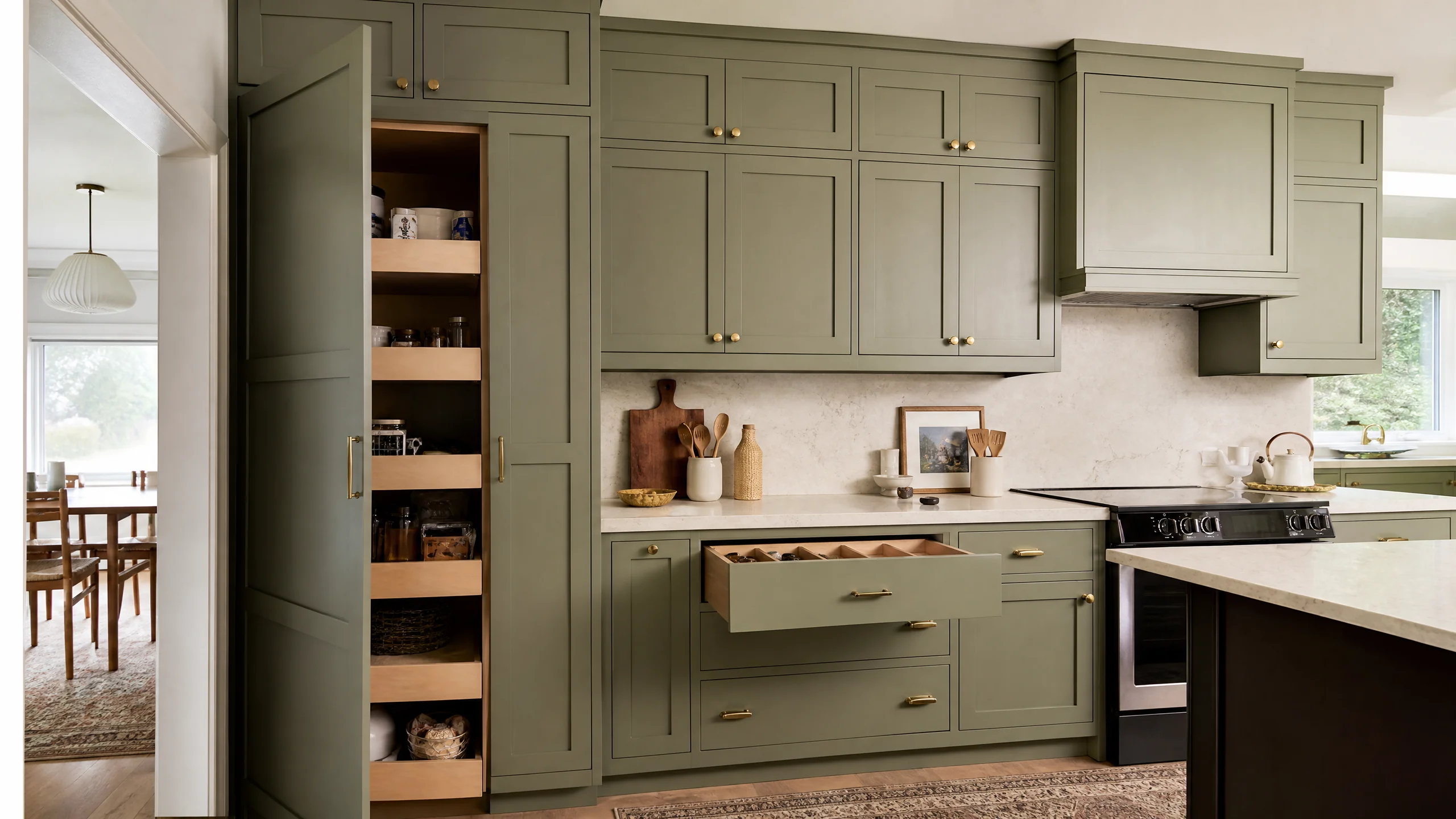
Key points
- Framed cabinets have a face frame of stiles and rails; frameless (European-style) boxes hang doors from the cabinet sides and give easier interior access.
- Overlay doors cover the cabinet face; inset doors sit flush inside the face frame and need more precise fitting.
- Consumer Reports recommends solid wood, dovetailed drawers instead of stapled particleboard, and 3/4-inch plywood shelves.
- KCMA certification means a cabinet line passed 14 third-party tests under ANSI/KCMA A161.1, including a 600-pound wall cabinet load test.
- NKBA guidance calls for full-access corner hardware and 165-degree hinges on base cabinets.
Why kitchen cabinet construction matters more than door style
Cabinets are usually the largest single line in a kitchen remodel, and most people replace all of them. Houzz's 2026 U.S. Kitchen Trends Study found that 68% of renovating homeowners replaced every cabinet, 27% replaced some and only 5% left them alone.
Source: Houzz 2026 U.S. Kitchen Trends Study.
That makes the box worth understanding before you look at a single door sample. The door is what you see. The box, the drawer and the hinge are what you use thousands of times a year, and they decide whether the kitchen still works smoothly in fifteen years. They also interact with the layout: a frameless box gains interior width in a narrow run, and the wrong corner unit can waste the most awkward square foot in the room.
Framed vs. frameless cabinets
The Kitchen Cabinet Manufacturers Association (KCMA) defines a face frame as the vertical "stiles" and horizontal "rails" that reinforce the cabinet and give the doors and drawers something to mount to. A frameless cabinet is built without that frame, and the doors and drawers mount directly to the sides of the box.
Consumer Reports describes frameless cabinets as European-style: the look is more contemporary and interior access is easier, because there is no frame edge narrowing the opening. Framed construction is the traditional American approach and works with every door style, including inset.
Sources: KCMA Glossary of Cabinet Terms; Consumer Reports Kitchen Cabinet Buying Guide.
| Feature | Framed (face frame) | Frameless (European-style) |
|---|---|---|
| How it's built | Stiles and rails on the front reinforce the box and carry the hinges | No face frame; doors and drawers mount to the cabinet sides |
| Interior access | The frame narrows the opening slightly | Easier, with a full-width opening |
| Door styles | Full overlay, partial overlay or inset | Typically full overlay |
| Look | Traditional to transitional | More contemporary, with tight, even gaps |
| Planning note | Frame width eats a little drawer and shelf space on every box | Box sides must be square and stiff, since there is no frame to hold them |
Neither is automatically better. Frameless boxes tend to suit drawer-heavy plans and tight runs where every inch of interior width counts. Framed boxes suit traditional kitchens and are the only route to true inset doors. Ask to see both in person and open the drawers on each.
Overlay vs. inset doors
KCMA defines a full overlay door or drawer front as one sized to cover the cabinet face with only minimal clearances. An inset door is fitted into the face frame and sits flush with it.
Source: KCMA Glossary of Cabinet Terms.
The practical difference shows up in three places. First, inset doors reveal the frame around every opening, which reads as furniture-like and traditional. Second, inset work leaves no margin for error: gaps are visible on all four sides, so the box, door and hinge must be precisely made and adjusted. Third, inset doors sit inside the opening, so drawers and pull-outs lose a little interior width compared with an overlay design. If your layout depends on wide drawers in a short run, check the interior dimensions before you fall for the look.
Box materials, drawers and shelves
This is the part of kitchen cabinet construction where cheap and well-made cabinets differ most, and where marketing is least helpful. Consumer Reports' buying guide recommends solid wood drawers with dovetail joinery instead of stapled particleboard, and 3/4-inch plywood shelves. KCMA defines a dovetail as a joint formed by tapered projections on one piece that interlock with matching notches in another, which is why it holds up to years of loaded pulls.
Sources: Consumer Reports Kitchen Cabinet Buying Guide; KCMA Glossary.
Cabinet boxes themselves are built from plywood, particleboard or MDF, and lines vary widely in thickness, edge banding and how the back and bottom are fastened. We found no independent, standards-based comparison of those box materials, so treat sweeping claims from either camp with caution. Better questions to ask the professional you're working with:
- What are the box sides, back and bottom made of, and how thick are they?
- How is the drawer box joined: dovetail, dowel, or staples?
- What are the shelves made of, and will they sag under a stack of plates?
- How does the sink base hold up to a leak?
- Is the line KCMA certified?
Note that Consumer Reports states it does not test cabinets at this time, so its guidance is construction advice, not a brand ranking.
KCMA certification and the A161.1 tests
The most useful independent quality marker is KCMA certification. According to KCMA, certified cabinets have passed 14 third-party tests under the ANSI/KCMA A161.1 standard, including a 600-pound load test, designed to simulate a lifetime of use. KCMA's own description of the tests gives a sense of what they check:
| Test area | What A161.1 checks |
|---|---|
| Shelves and bottoms | Loaded at 15 lb per sq. ft. and held for seven days |
| Wall cabinets | Gradually loaded to 600 lb |
| Base cabinet front joints | 250 lb with drawer rails, 200 lb without |
| Doors | 25,000 open-and-close cycles through a full 90-degree swing, plus a 65 lb door load test |
| Drawers | Loaded at 15 lb per sq. ft. and run through 25,000 cycles, plus a 3 lb drop test |
| Finish | Hotbox at 120°F and 70% relative humidity for 24 hours, a cold check at -5°F, and stain tests including mustard for one hour |
Certification doesn't make one door style better than another, and an uncertified custom shop can still build excellent cabinets. It does give you a baseline when you're comparing lines you can't inspect side by side.
Stock vs. semi-custom vs. custom
The NKBA's planning guidelines note that cabinet production standards vary by stock, semi-custom and custom manufacturing. Consumer Reports describes the three tiers like this:
| Grade | What it is | Consumer Reports price guide | Best fit |
|---|---|---|---|
| Stock | Inexpensive, off-the-shelf cabinets in set sizes | From about $70 per linear foot | Simple layouts that fit standard widths |
| Semi-custom | Made to order with many custom options | From about $150 per foot (mid-level) to $500 per foot (premium) | Most remodels: standard boxes with modified sizes and inserts |
| Custom | Built to your exact specifications | The most expensive option; no per-foot figure given | Odd dimensions, inset work, older homes with out-of-square walls |
Also: NKBA Planning Guidelines, 4th ed. summary, §4.1.
Stock is a smaller share of the market than many people assume. The Houzz 2026 Kitchen Trends Study found custom and semi-custom cabinets make up most new cabinets, with stock at 10%. In a 1960s Holladay kitchen with walls that aren't quite square, semi-custom or custom sizing often earns its cost by eliminating filler strips and dead space.
Source: Houzz 2026 U.S. Kitchen Trends Study.
Ask about delivery timing early, too. Lead times vary by line and season, so get the current quoted lead time in writing from your remodeler rather than relying on a typical range.
Corners, hinges and drawers: the NKBA guidance
The fourth edition of the NKBA planning guidelines includes a few specific cabinet recommendations that are easy to check on a plan:
- Corners: when a corner cabinet is planned, use components that allow full access to the interior. A blind corner with a fixed shelf fails this test.
- Hinges: use 165-degree hinges on base cabinet doors, so the door swings clear and pull-outs can slide past it.
- Drawers: drawers should open without excessive force and give full access to the drawer box, which points to full-extension slides.
Source: NKBA Kitchen & Bath Planning Guidelines, 4th ed. summary, §4.1.
These details are decided at the cabinet-order stage, which is why they belong in the plan rather than on a punch list. For storage targets and corner solutions in more depth, see the pantry and storage planning guide.
Order of decisions: layout first, then cabinet sizes and interiors (drawers, pull-outs, corners), then box construction and grade, then door style and finish. Choosing the door first tends to lock in a cabinet line before anyone has checked whether it makes the sizes your layout needs.
When refacing is the better choice
Refacing keeps the existing cabinet boxes and replaces the doors, drawer fronts and visible surfaces, usually with new hinges and hardware. It can make sense when three things are true: the boxes are solid and dry, the layout already works, and you have no plans to move plumbing, appliances or walls.
It is a poor fit when the real problem is the layout. If the kitchen needs a wider aisle, a different sink location, an island or a pantry wall, new doors on old boxes only postpone the remodel. Refacing also leaves the original drawer boxes and corner units in place unless you replace them too. Have the boxes inspected, especially the sink base, before deciding.
Whichever route you take, the cabinet plan should be part of one complete kitchen plan, coordinated with the countertops, plumbing, lighting and flooring. Our custom cabinetry page covers how that comes together in a Holladay remodel.