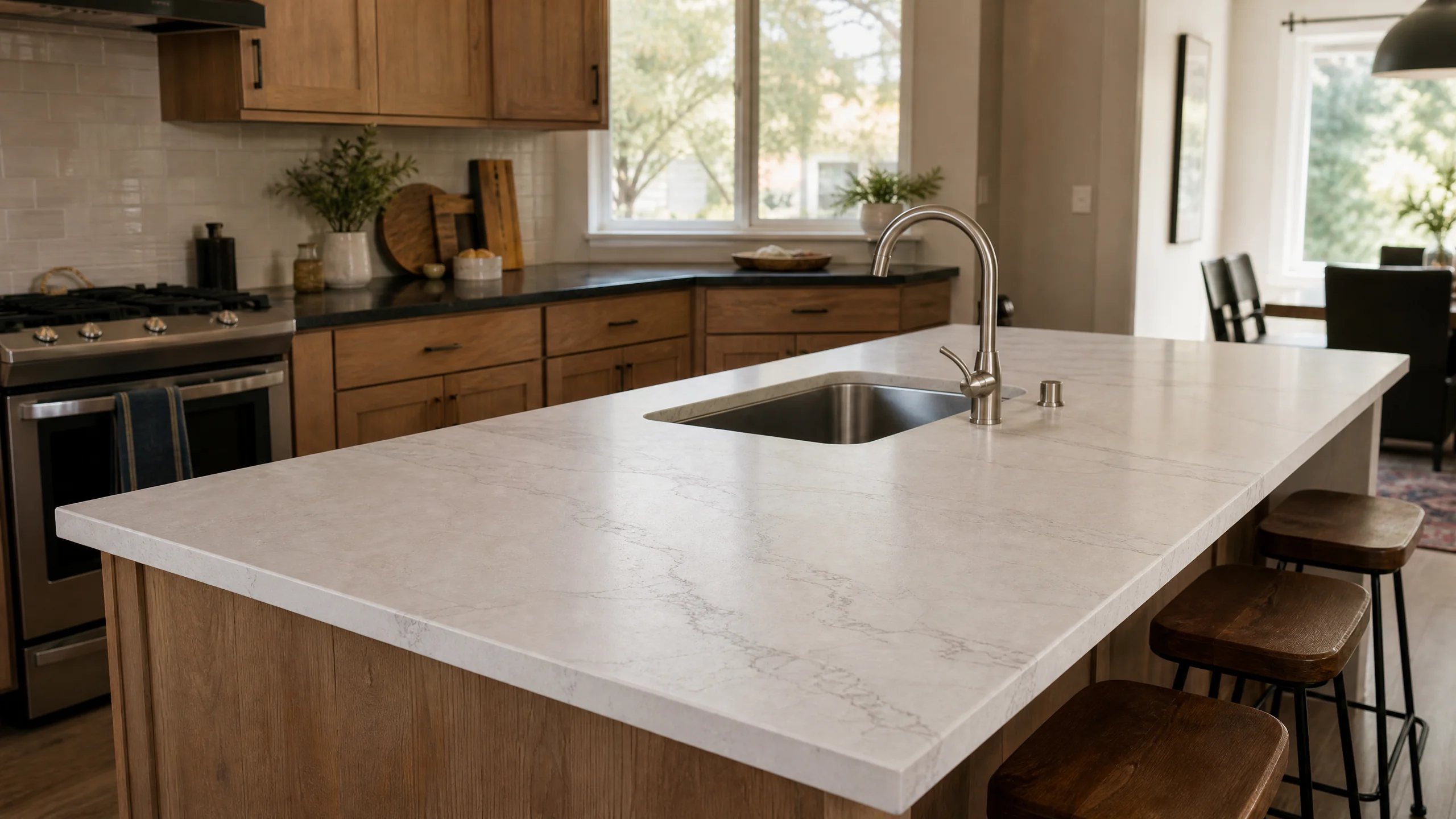
Key points
- Engineered quartz is roughly 90% ground quartz bound with resins and pigments, and it doesn't need sealing.
- Quartz manufacturers advise against setting hot pans directly on the surface and exclude outdoor installations from warranty.
- Granite handles hot pans easily; sealing advice varies by stone. Porous quartzites need sealing.
- Some "quartzite" slabs are actually marble. A simple glass scratch test tells them apart.
- Silica dust is a hazard for fabrication workers, not for homeowners using an installed countertop. Ask fabricators how they control it.
What each material actually is
Quartz countertops are engineered. Caesarstone describes its surfaces as roughly 90% loose quartz, with the rest made up of resins and pigments. The Natural Stone Institute's consumer site, which represents the natural stone industry, puts quartz at 93% mineral quartz and 7% binders by weight, and says the finished product may be 30-40% resin by volume. Either way, the resin is what makes quartz non-porous and consistent, and it's also what limits its heat and sun tolerance.
Sources: Caesarstone, "Your Complete Guide to Quartz Surfaces"; usenaturalstone.org (Natural Stone Institute).
Granite is a natural igneous stone quarried in slabs. Every slab is different, which is both its appeal and the reason you should see the actual slab before it's cut.
Quartzite is a natural metamorphic stone. The trouble is the name: the Natural Stone Institute notes that marble is sometimes incorrectly sold as quartzite, and so is sandstone. True quartzite rates 7 on the Mohs hardness scale and will easily scratch glass, so a scratch test on a glass tile is a quick way to check a sample. Marble won't pass it.
Source: usenaturalstone.org, "Properties of Quartzite".
Quartz vs. granite vs. quartzite at a glance
| Property | Quartz (engineered) | Granite | Quartzite |
|---|---|---|---|
| Composition | About 90% quartz plus resins and pigments (Caesarstone) | Natural stone | Natural stone; watch for mislabeled marble or sandstone |
| Hardness | Mohs 7 (Cambria, ASTM C-1895) | Varies by slab | Mohs 7; scratches glass |
| Hot pans | Use a trivet; fine for normal day-to-day heat | Handles hot pots and pans easily | Varies; ask the fabricator |
| Sealing | None needed | Some recommend a penetrating sealer; some leave it unsealed | Porous quartzites need sealing; sealers last 1-10 years |
| Absorption and acids | Negligible moisture absorption (Cambria, ASTM C-97) | Varies by slab and sealer | Not etched by common acids |
| Sunlight and outdoors | Outdoor use excluded from Cambria's warranty | Varies by stone | Varies by stone |
| Look | Consistent color and pattern | Unique, often speckled | Unique, often marble-like veining |
Heat and thermal shock
Heat is where quartz gives up the most. Caesarstone advises against placing hot pans directly on its quartz, saying its heat resistance is sufficient for normal, day-to-day use, and it points customers who need more heat tolerance to its porcelain line. Cambria's specification sheet says its quartz passes 10 cycles of the ASTM C-484 thermal shock test, but its warranty still excludes damage from direct or sustained heat or cold and sudden temperature changes.
Sources: Caesarstone; Cambria specification sheet, version 25AH-0522; Cambria Full Lifetime Warranty.
Granite is the traditional answer for people who pull pans straight from the oven; the Natural Stone Institute describes it as easily handling hot pots and pans. Whatever you choose, plan landing space next to the range and wall oven so hot pans have somewhere sensible to go. That's a layout decision, and it matters more than the material.
Source: usenaturalstone.org, granite vs. engineered quartz.
Sealing, stains and daily care
Quartz needs no sealing. Caesarstone contrasts this with natural stone that may need resealing as often as twice a year. Cambria lists moisture absorption as negligible under ASTM C-97, which is why wine and oil tend to wipe off quartz.
Natural stone is less predictable. For granite, some professionals recommend a penetrating sealer while others let it breathe with no sealer at all, which tells you the answer depends on the stone. For quartzite, the Natural Stone Institute says porous varieties need sealing, that sealers last anywhere from 1 to 10 years, and that darkening around the sink is the sign to watch for. True quartzite won't be etched by common kitchen acids like lemon juice, but marble sold as quartzite will.
Sources: usenaturalstone.org, "Caring for Quartzite Countertops"; "Properties of Quartzite"; Cambria spec sheet.
Easy home test: before committing to a natural stone, put a few drops of water on an offcut or the back of a sample and see whether it darkens within a few minutes. If it does, ask the fabricator about sealing before installation and how often to reseal.
Sunlight, UV and outdoor kitchens
If the counter sits under a big south or west window, or you're planning an outdoor kitchen, quartz is the risky choice. Cambria's warranty excludes outdoor installations, including partially covered or sheltered areas. The Natural Stone Institute goes further, claiming quartz can fade or yellow within weeks of direct sunlight; that's a natural-stone trade group talking, so weigh it accordingly, but the manufacturer's own warranty exclusion makes the same point.
Sources: Cambria Full Lifetime Warranty; usenaturalstone.org.
Cambria also reports its quartz unaffected after 300 freeze-thaw cycles, but freeze-thaw is not the same thing as sun exposure, and the warranty exclusion still applies.
Source: Cambria specification sheet, version 25AH-0522.
Silica: a question for the fabrication shop
You may have read about engineered stone bans. Here's what the sources actually say, and why it matters to you as a buyer rather than as a user. The hazard is breathing crystalline silica dust while slabs are cut and ground in a shop. The sources below are about worker exposure; they do not describe a risk from using an installed countertop.
| Material | Crystalline silica content |
|---|---|
| Engineered stone | More than 90% for some types; some contain less than 50% |
| Quartzite | More than 90% |
| Granite | Up to 50% |
| Recycled glass | Less than 0.2% |
OSHA's permissible exposure limit is 50 micrograms per cubic meter averaged over eight hours, with an action level of 25. OSHA's own hazard analysis cites a 2023 study that identified 52 young men with silicosis linked to engineered stone, median age 45, and reports that about a quarter of breathing-zone samples from its 2022 inspections exceeded the limit. Between September 2023 and July 2024, OSHA found violations in 149 of 160 inspections of cut-stone shops.
Sources: AIHA; OSHA, "Lessons Learned and Initial Findings from OSHA's Emphasis Program on Silica in Engineered Stone".
Regulators elsewhere have acted. Australia made it illegal from July 1, 2024 to manufacture, supply, process or install engineered stone benchtops, panels or slabs containing at least 1% crystalline silica. In California, the Cal/OSHA Standards Board was reported in May 2026 to have voted to begin banning fabrication of high-silica artificial stone, and released a draft emergency regulation on September 16, 2026. As of October 1, 2026, that California rule was still a proposal, not final.
Sources: Safe Work Australia; OH&S, May 26, 2026; Brayton Purcell, Sept. 21, 2026.
Notice that quartzite and granite also contain silica, so this isn't a reason to switch materials on its own. It's a reason to ask any fabricator how they control dust when cutting and grinding, whether they monitor worker exposure against the OSHA limit, and how much cutting will happen in your house versus the shop.
Utah hard water and your countertop
Holladay homes get water from Salt Lake City Public Utilities, Jordan Valley Water Conservancy District or Holliday Water Co., depending on the address. Every verified figure for the valley's suppliers lands in the U.S. Geological Survey's "hard" or "very hard" range: Salt Lake City's 2025 report lists 121 to 198 mg/L at its treatment plants and up to 487 mg/L from wells blended in during summer, and Jordan Valley Water gives 170 mg/L (10 grains per gallon).
Sources: City of Holladay utilities; SLC Public Utilities 2025 Water Quality Report; Jordan Valley Water; USGS hardness classes.
Hard water leaves mineral spots where water sits and dries, which is mostly the counter around the sink and faucet. On any surface, wiping the sink area dry is the simplest defense. On natural stone, use the cleaner your fabricator recommends rather than a strong descaler, and keep an eye on the area around the sink for darkening that signals the sealer is wearing. If you're re-plumbing the sink anyway, it's a reasonable time to ask about a softener loop or point-of-use filter.
How to choose
- Choose quartz if you want consistent color, no sealing and easy stain cleanup, and the counter stays indoors out of strong direct sun.
- Choose granite if you set hot pans down without thinking and want a natural slab with its own pattern.
- Choose quartzite if you want a marble look with more hardness and acid resistance, and you've confirmed the slab really is quartzite.
Then size the counters to the plan: landing space beside the sink, range and refrigerator, seams placed where they make sense and overhangs that suit the seating. Material is the last decision, not the first. Our countertop installation page covers templating and how counters fit into one complete remodel.
Sources
- Caesarstone, "Your Complete Guide to Quartz Surfaces"
- Cambria, Product Specification Sheet (version 25AH-0522)
- Cambria, Full Lifetime Warranty (US/Canada)
- Natural Stone Institute (usenaturalstone.org), granite vs. engineered quartz
- Natural Stone Institute, "Properties of Quartzite"
- Natural Stone Institute, "Caring for Quartzite Countertops"
- AIHA, "OSHA, NIOSH Urge Countertop Fabrication Shops to Adopt Silica Controls" (March 5, 2026)
- NIOSH Publication 2026-101
- OSHA, Lessons Learned from the Emphasis Program on Silica in Engineered Stone
- Safe Work Australia, engineered stone prohibition
- OH&S, "California Moves to Ban High-Silica Artificial Stone" (May 26, 2026)
- Brayton Purcell, California draft rule (Sept. 21, 2026)
- Salt Lake City Public Utilities, 2025 Water Quality Report
- Jordan Valley Water Conservancy District, customer information
- USGS, Hardness of Water
- City of Holladay, Utilities